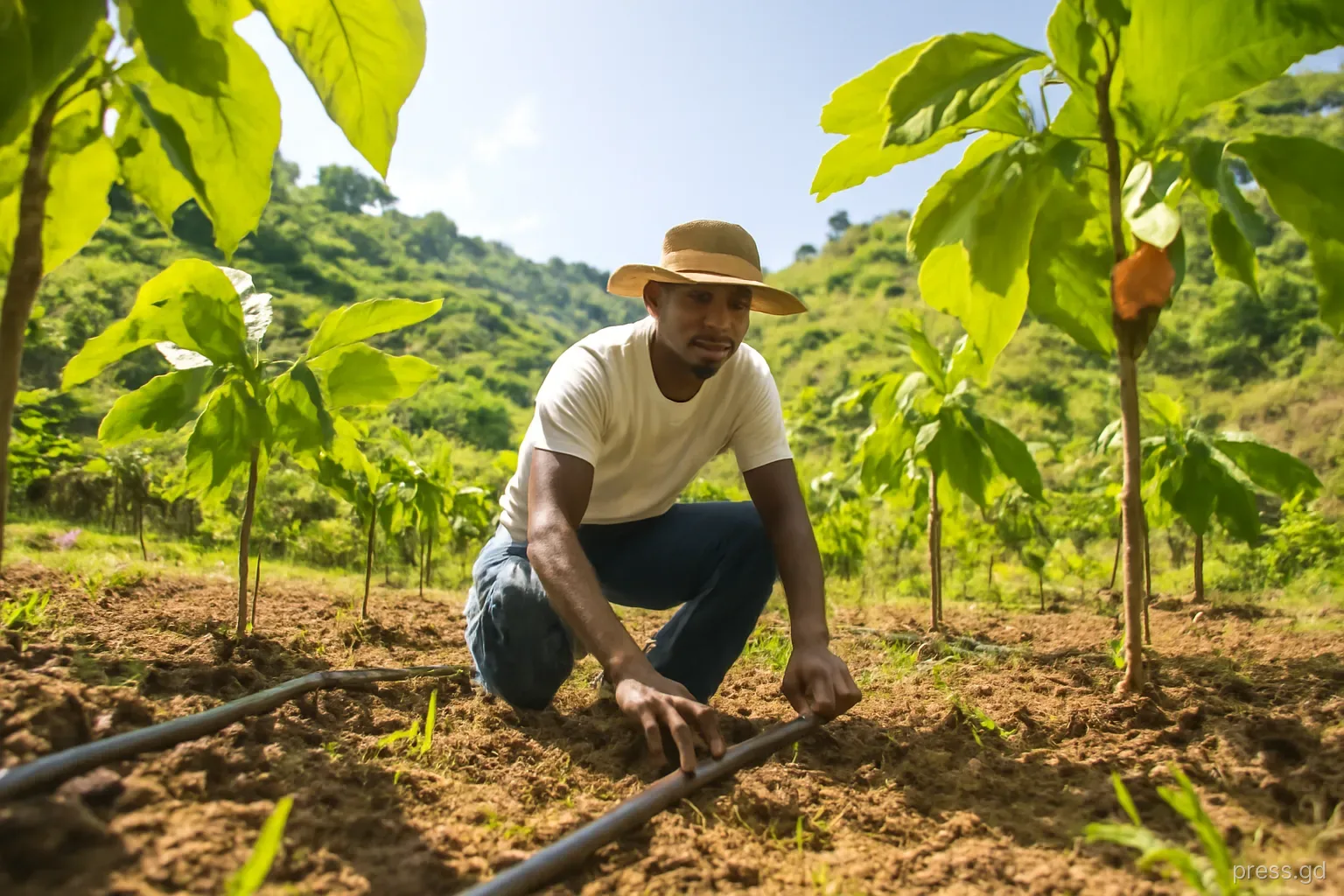
Grenada's farmers and fishers feel changes in the weather before most people read about them. A dry season that runs weeks longer than usual leaves young vegetables wilting on hillside plots in St Andrew and St David. A single downpour can wash topsoil into the rivers and onto the roads. At sea, fishers report rafts of sargassum seaweed clogging nets and engines, and reef fish moving or thinning as the water warms.
These are the two sectors where climate change meets daily income most directly. Agriculture once dominated the economy through nutmeg, cocoa and bananas; it now earns less than tourism but still feeds households, supplies markets and employs many rural people. Small-scale fishing sustains towns from Gouyave to Grenville and across Carriacou. This explainer looks at the main climate pressures, how farmers and fishers are adapting, and what policy can and cannot do.
The weather pattern farmers now plan around
Grenada has a dry season, roughly from January to May, and a wet season that coincides with the Atlantic hurricane season from June to November. Climate projections for the eastern Caribbean point toward a drier region overall, with more intense individual rainfall events, rising temperatures and stronger hurricanes, although year-to-year variation remains large.
For farmers, the combination is difficult: longer or deeper droughts stress crops and livestock, while heavy rain on steep, recently cleared land causes erosion and landslides. Much of Grenada's farmland is on slopes, and many small farmers depend on rain rather than irrigation. In the drier south and on Carriacou, water scarcity is already the main limit on what can be grown.
Heat also matters. Higher temperatures can reduce yields of some vegetables, affect flowering and fruit set in tree crops and increase water needs. Pests and diseases may spread differently as conditions shift, which adds to the cost of protecting crops.
What it means for the main crops
Nutmeg. Grenada's signature crop grows on tall trees that are vulnerable to hurricane winds. Ivan in 2004 destroyed a large share of the trees, and young trees take years to bear. Replanting has been supported by the Grenada Cooperative Nutmeg Association and government programmes, but each major storm reopens the problem.
Cocoa. Cocoa is somewhat more resilient and recovered faster after Ivan, helped by growth in local chocolate making. It still needs reliable moisture and shade, and drought during flowering can reduce the crop.
Bananas and plantains. Easily flattened by strong winds but quick to replant, they illustrate the trade-off between short-cycle crops that recover fast and tree crops that last longer.
Vegetables and root crops. Produced by many small farmers for local markets and hotels, they are highly sensitive to drought and to waterlogging after heavy rain. Shortages push up market prices and increase reliance on imports.
Livestock. Small herds of goats, sheep, cattle and poultry suffer from heat stress and shortages of water and fodder in long dry seasons, especially on Carriacou.
Pressures at sea
Grenada's fishing fleet is largely small-scale: open boats and pirogues fishing close to shore for reef species, and longer trips offshore for tuna, mahi-mahi, kingfish and other pelagic species. Gouyave in St John is the best-known fishing town, and Grenville, Grand Mal, Carriacou and Petite Martinique all have strong fishing traditions.
Warming seas cause coral bleaching, which weakens the reefs that shelter juvenile fish. Sargassum, which has arrived in the eastern Caribbean in large quantities in many years since 2011, accumulates on east-facing coasts, fouls nets and outboard engines, and can block boat access to landing sites. At the same time, some fishers report that sargassum mats attract certain pelagic fish, so the impacts are not uniform.
Hurricanes cause the most sudden losses. Beryl destroyed or damaged many boats, engines and gear on Carriacou and Petite Martinique, where fishing is central to the economy. Even moderate storms and swells keep boats in harbour for days, a direct loss of income for crews paid by the catch.
How farmers and fishers are adapting
Adaptation in both sectors is mostly practical and incremental. Common measures include:
- Water harvesting and storage: tanks, ponds and gutters to catch rain for use in dry months, often supported by donor-funded projects.
- Drip irrigation and mulching to use limited water more efficiently and keep soil moisture during dry spells.
- Soil conservation on slopes: contour planting, terraces, cover crops and keeping vegetation along ravines to reduce erosion.
- Mixed planting and windbreaks: combining tree crops with shorter crops and planting rows of trees to reduce wind damage, rather than relying on one crop.
- Fish aggregating devices: anchored floating structures that attract pelagic fish, allowing fishers to target offshore species and reduce pressure on stressed reefs.
- Safety at sea: better weather information, communication equipment and training, so crews can avoid dangerous conditions.
- Diversification: agro-processing, sea moss cultivation, agritourism and part-time work in other sectors to spread risk.
What policy can and cannot do
Government plays several roles. The Ministry of Agriculture's extension officers advise farmers on techniques, crop varieties and pest control. The Fisheries Division manages licences, closed seasons for protected species, marine protected areas and data collection on catches. Climate adaptation projects, many funded by international partners, finance irrigation, water storage, farm roads, cold storage and fisheries infrastructure.
Insurance remains a weak point. Few small farmers or fishers have insurance that would replace lost income after a disaster. Regional efforts have explored parametric policies for fishers and farmers, which pay out on weather triggers, but uptake is limited by cost and awareness. After major storms, support usually arrives as planting material, tools, replacement gear or cash grants, often months later.
There are limits that policy cannot remove. Land on steep slopes will always be exposed to erosion; reefs depend on global ocean temperatures; and hurricanes cannot be prevented. The realistic goal is to reduce losses, speed up recovery and keep farming and fishing viable as livelihoods, particularly for younger Grenadians weighing them against tourism jobs or emigration.
Mistakes that make climate losses worse
Clearing slopes completely. Removing all vegetation from hillsides before planting leaves soil unprotected against the first heavy rain. Keeping strips of cover reduces erosion.
Planting a single crop. Relying on one tree crop concentrates hurricane risk. Mixed systems spread losses and keep some income flowing.
Ignoring forecasts. Fishing in deteriorating weather to make up lost days is a recurring cause of accidents. Grenada Meteorological Service forecasts and marine warnings are there to be used.
Burning crop residues. Burning to clear land degrades soil and can start bush fires in the dry season; composting or mulching retains nutrients and moisture.
Waiting for help after the event. Registering with farmer or fisher associations and keeping records of boats, gear and plots before a disaster makes it easier to qualify for assistance afterward.
Food security and the import bill
Climate pressure on local farming has a national dimension. Grenada imports a large share of its food, including staples, meat and processed goods, and the import bill rises when local harvests fail. A drought that cuts vegetable production pushes hotels, supermarkets and households toward imported produce, sending money out of the economy and exposing consumers to shipping costs and global price swings.
Governments across the Caribbean have committed through CARICOM to reducing the regional food import bill, and Grenada's agricultural policy emphasises import substitution, greater local supply to hotels and support for agro-processing. Climate resilience is part of that agenda: crops that survive dry spells and storms are a condition for any lasting reduction in imports.
Local markets, including the Saturday market in St George's and parish markets, are a good barometer. When dry weather persists, the range of local vegetables narrows and prices for items such as tomatoes, lettuce and cucumbers rise, an early sign of climate stress felt by every household.
Frequently asked questions
Is climate change making Grenada drier?
Regional projections point toward a drier eastern Caribbean overall, with more intense individual rainfall events and higher temperatures. Year-to-year variation remains large, so wet years still occur, but planning for longer dry spells is considered prudent by agricultural advisers.
Why is nutmeg so vulnerable to hurricanes?
Nutmeg grows on tall trees with relatively shallow roots that can be snapped or uprooted by strong winds. New trees take several years to begin bearing, so the income loss lasts long after the storm, as Grenada experienced after Hurricane Ivan.
How does sargassum affect fishers in Grenada?
Large mats of sargassum can clog nets and outboard engines and block access to landing sites on east-facing coasts. It can also attract some pelagic fish, so effects vary, but heavy influxes generally disrupt fishing and coastal life.
What are fish aggregating devices?
They are anchored floating structures placed offshore that attract pelagic fish such as tuna and mahi-mahi. They help fishers find catches more efficiently and can reduce pressure on reef fish, but need maintenance and fair management among users.
Can small farmers in Grenada get crop insurance?
Options are limited. Some regional schemes have been piloted, including parametric products, but most small farmers are uninsured. After disasters, support usually comes through government or donor programmes, so registration with the Ministry of Agriculture and associations matters.
Who advises farmers on adapting to climate change?
Extension officers from the Ministry of Agriculture, commodity associations such as the nutmeg and cocoa bodies, regional institutions and donor-funded projects provide advice, training and sometimes inputs. Farmer groups are also an important way to share local experience.