Grenada is an independent country, yet its head of state is King Charles III, who lives in London. His representative in Grenada is the Governor-General, who opens Parliament, swears in ministers, signs laws and appears at national ceremonies. To many people the role looks purely decorative. It is mostly ceremonial, but not entirely, and at one moment in Grenada's history the Governor-General became the only constitutional authority left standing.
This explainer sets out what the Governor-General does, how the person is chosen, the limited but real discretionary powers, and the debate over whether Grenada should one day replace the monarchy with a president.
How the Governor-General is appointed
Under the 1973 Constitution, the Governor-General is appointed by the monarch and holds office at the monarch's pleasure. By convention, the monarch acts on the advice of Grenada's Prime Minister, so in practice the Prime Minister chooses the Governor-General. There is no fixed term. Governors-General have served periods ranging from a few years to well over a decade.
The holder is always a Grenadian. Appointees have included a doctor, lawyers, a public servant and, since 2013, a scientist: Dame Cécile La Grenade, a food scientist, who became the first woman to serve as Governor-General of independent Grenada. Before independence, the Crown was represented by a governor; Dame Hilda Bynoe held that post from 1968 until her resignation in 1974.
The Governor-General's office is based in St George's, supported by a small staff headed by a secretary. The Governor-General is expected to be politically neutral, does not belong to a party in office and avoids public comment on political controversies.
The powers exercised on advice
Appointing ministers. Ministers are appointed by the Governor-General on the Prime Minister's advice, and can be removed the same way.
Assenting to bills. Every Act of Parliament needs the Governor-General's assent. This is given as a matter of course for bills properly passed.
Dissolving Parliament. The Governor-General dissolves Parliament and so triggers a general election, normally when the Prime Minister advises it. Parliament was dissolved in this way on 2 October 2026, ahead of the general election called for 5 November 2026.
Senate appointments. Senators are appointed on the advice of the Prime Minister, of the Leader of the Opposition, or of the Prime Minister after consultation, depending on the seat.
Prerogative of mercy. Pardons and commutations of sentences are granted in the name of the Governor-General, acting on the advice of a designated minister after a committee has considered the case.
The discretionary powers
A small number of decisions are left to the Governor-General's own judgement, and these are where the office matters most. The most important is appointing the Prime Minister. After an election, the Governor-General appoints as Prime Minister the member of the House of Representatives who appears best able to command the support of the majority of members. When one party wins a clear majority, there is no real discretion. In a hung Parliament, or after defections, the judgement could become significant.
The Governor-General also appoints the Leader of the Opposition, the member who leads the largest group opposed to the government. When the governing party has won every seat, as happened in 1999, 2013 and 2018, there is no member to appoint. In those cases the Governor-General has used discretion over the three Senate seats normally filled on the opposition's advice, and a convention developed of choosing people from the defeated party.
The Constitution also provides for removing a Prime Minister who loses a vote of no confidence in the House and neither resigns nor advises a dissolution. Such provisions are rarely if ever used, but they exist as a constitutional safety net.
October 1983: when the office mattered most
The People's Revolutionary Government suspended the Constitution in 1979 but kept Sir Paul Scoon in office as Governor-General. After the killing of Prime Minister Maurice Bishop on 19 October 1983 and the collapse of the PRG, Scoon was the only remaining figure with a recognised constitutional position. His role in the events that followed, including a request for outside assistance that was cited by the intervening governments, has been the subject of extensive debate, particularly over its timing and form.
After the intervention of 25 October, Scoon became the source of legal authority for the interim period. He appointed an Interim Advisory Council to run the government and presided over the restoration of the Constitution and the return to elections in December 1984. Whatever view is taken of 1983, the episode shows why constitutional lawyers say the Governor-General's reserve role is not merely symbolic: when other institutions fail, the office provides continuity.
Ceremonial and community roles
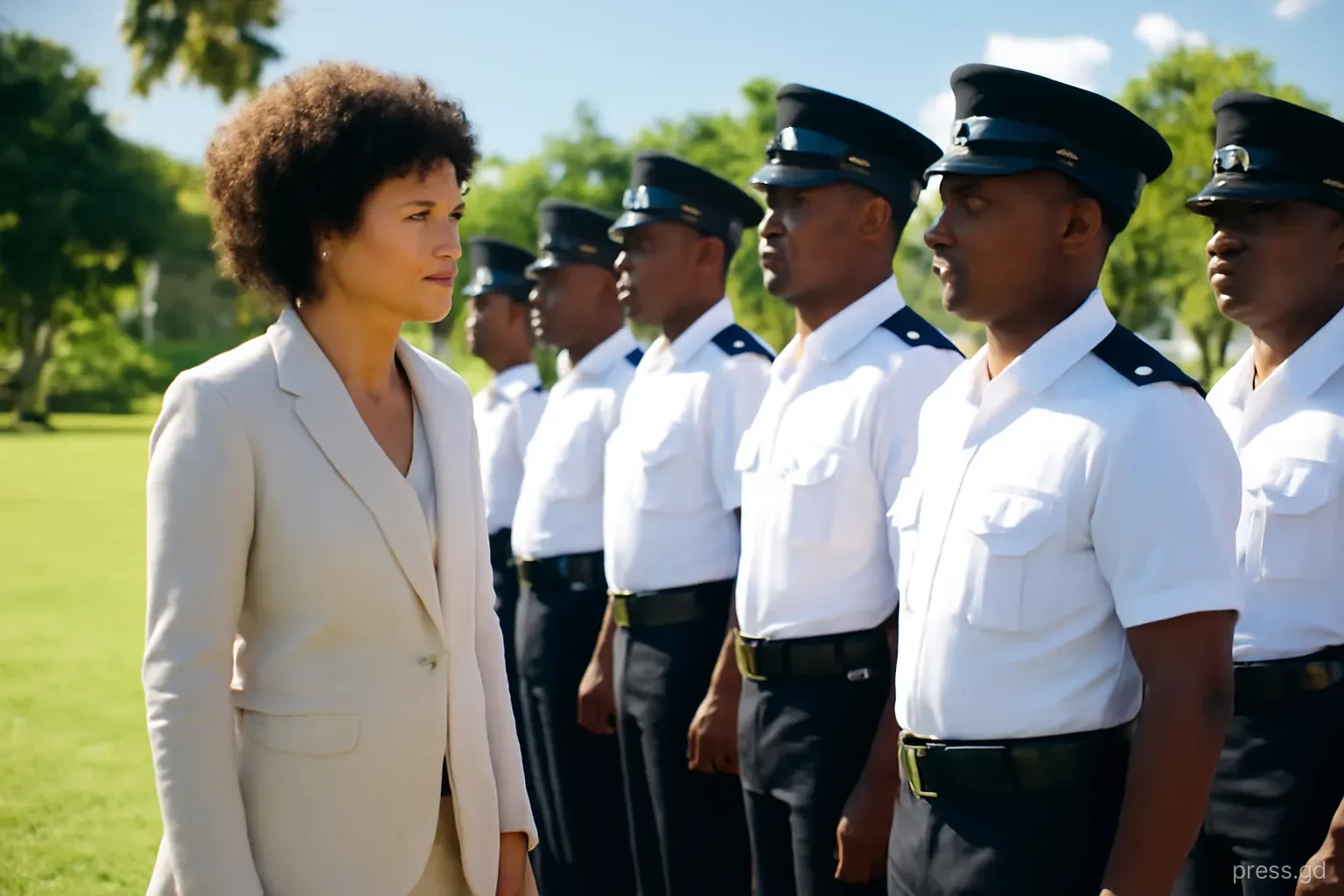
Most of the Governor-General's public time is spent on ceremonial and civic duties. These include the formal opening of Parliament with the Throne Speech, which sets out the government's programme and is written by the government, not the Governor-General; swearing in ministers, senators and judges' oaths where required; receiving the credentials of ambassadors and high commissioners; and presiding at the Independence Day parade on 7 February.
The Governor-General also confers national honours and awards on behalf of the state, acts as patron of many charities and organisations, and visits schools, communities and Carriacou and Petite Martinique. After disasters, such as Hurricane Beryl's impact on Carriacou and Petite Martinique in July 2024, the Governor-General has a visible role in national solidarity, even though relief and recovery are run by the government and its agencies.
The republic question
Several Caribbean countries have replaced the monarchy with a president, most recently Barbados in November 2021. Trinidad and Tobago, Dominica and Guyana did so decades earlier. In Grenada, the issue resurfaces from time to time, particularly around royal visits, coronations and discussions of reparations for slavery, and it has been raised by politicians and commentators across the spectrum.
Becoming a republic would require amending the Constitution, including provisions that need approval by two-thirds of voters in a referendum. The difficulty of passing constitutional referendums in Grenada, illustrated by the defeats of 2016 and 2018, is one reason the question has not moved quickly. A frequently misunderstood point is that becoming a republic would not mean leaving the Commonwealth: most Commonwealth members are republics. Nor would it automatically change the final court of appeal, which is a separate constitutional question.
Governors-General since independence
Grenada has had six Governors-General since 1974. Their backgrounds show the range of people chosen for the office, and their tenures show that there is no fixed term: the length of service depends on the monarch's pleasure, which in practice means the wishes of successive Prime Ministers and the holder's own plans.
- Sir Leo de Gale (1974 to 1978): the first Governor-General, appointed at independence.
- Sir Paul Scoon (1978 to 1992): served through the revolution, the events of 1983 and the restoration of parliamentary government.
- Sir Reginald Palmer (1992 to 1996): an educator by background.
- Sir Daniel Williams (1996 to 2008): a lawyer and former politician who held the office for twelve years, including through Hurricane Ivan in 2004.
- Sir Carlyle Glean (2008 to 2013): a former educator and public servant.
- Dame Cécile La Grenade (from 2013): a food scientist, the first woman to hold the office since independence.
Common misunderstandings about the office
The Governor-General does not represent the British government. Since independence, the office represents the monarch as King of Grenada, a separate legal title, and acts on the advice of Grenadian ministers. London has no role in appointing or directing the Governor-General beyond the monarch's formal appointment on the Prime Minister's advice.
Nor does the Governor-General write the Throne Speech, choose ministers, or decide election dates; those choices belong to the Prime Minister. When the Governor-General is abroad or unable to act, a deputy or acting Governor-General carries out the functions, so the office is never vacant in practice. Finally, the Governor-General's personal views on political questions are deliberately kept private, which is why speeches tend to focus on national unity, youth, culture and service rather than policy.
Frequently asked questions
Who is the head of state of Grenada?
The head of state is King Charles III, as King of Grenada. He is represented in Grenada by the Governor-General, who carries out the monarch's constitutional functions locally. Dame Cécile La Grenade has held the office since 2013.
Who chooses Grenada's Governor-General?
The monarch formally appoints the Governor-General, but by convention acts on the advice of Grenada's Prime Minister. In practice, the Prime Minister selects the person. There is no fixed term, and the office is always held by a Grenadian.
Can the Governor-General dismiss the government?
Only in narrow circumstances defined by the Constitution, such as when a Prime Minister has lost the confidence of the House and will neither resign nor seek a dissolution. These powers are a safety net and are almost never used.
What did the Governor-General do in 1983?
Sir Paul Scoon remained Governor-General under the PRG. After Maurice Bishop was killed, he was the only recognised constitutional authority. His request for assistance was cited by the intervening states, and he later appointed the Interim Advisory Council that ran Grenada until the 1984 election.
Could Grenada become a republic?
Yes, but it would require amending the Constitution through a process that includes a referendum needing a two-thirds majority of votes cast. No government has yet put that question to voters. A republic could remain in the Commonwealth, as Barbados has done.