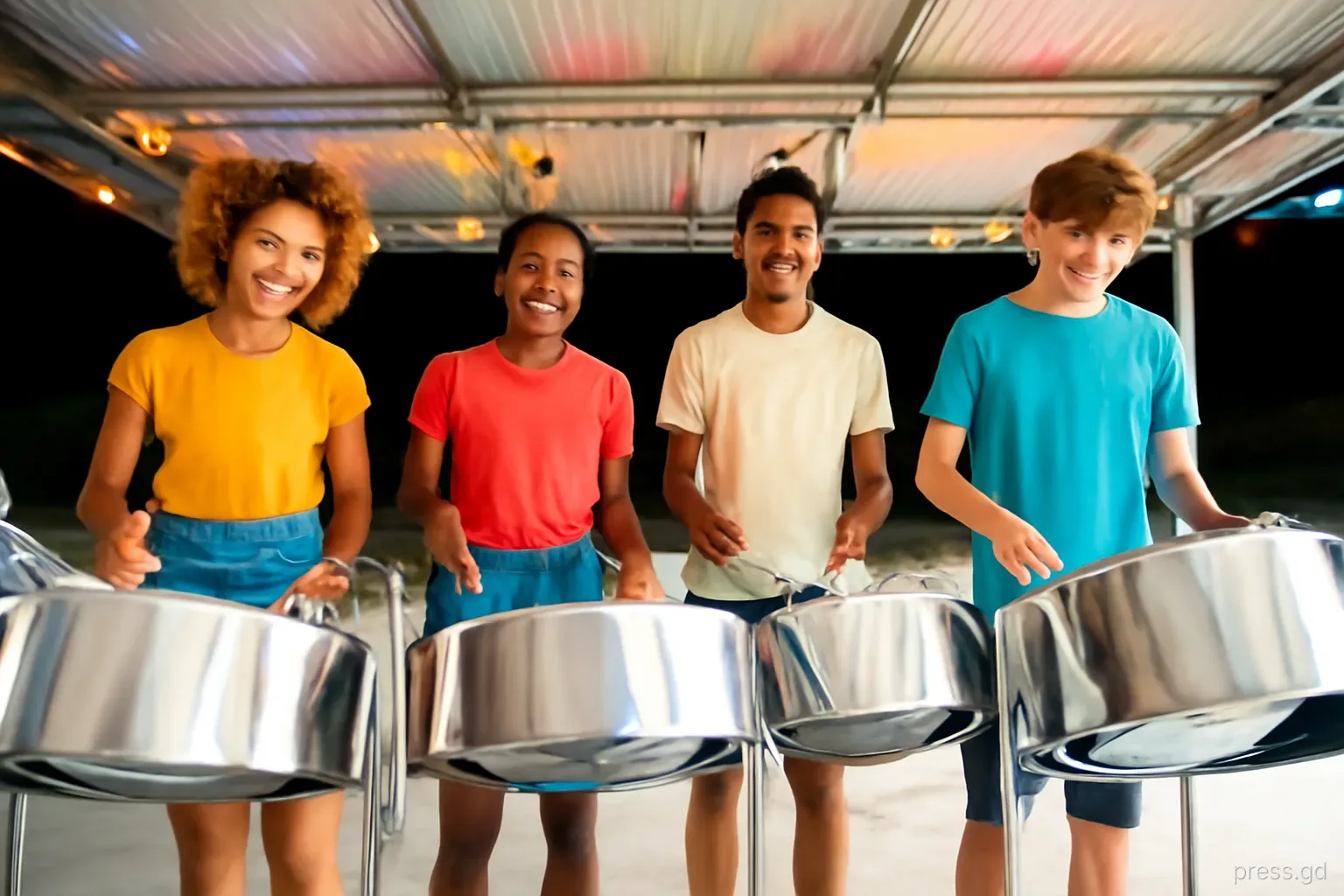
On a weeknight in July, drive through almost any Grenadian community with a steelband and you will hear it before you see it: the same eight bars repeated twenty times, then a pause, a shouted correction, and the same eight bars again. This is the panyard in Panorama season, and it is one of the most intense rehearsal processes in Caribbean music.
Steelpan was invented in neighbouring Trinidad, but it took root across the Eastern Caribbean, and Grenada has a steelband culture with its own rivalries, heroes and traditions. This explainer looks at how a steel orchestra is organised, what happens in the weeks before Panorama, how the instruments work and why the panyard still matters to the communities around it.
A short history of pan in Grenada
The steelpan emerged in Trinidad in the late 1930s and 1940s, when musicians in Port of Spain began beating and shaping metal containers, then oil drums, into tuned instruments. The movement spread quickly through the region, carried by migrants, sailors and returning workers. Grenada's close ties to Trinidad, through family, labour migration and carnival, meant steelbands appeared on the island from the post-war years.
Early bands were often viewed with suspicion by the respectable classes, associated with rough neighbourhoods and street fights between rival groups, a pattern also seen in Trinidad. Over time, the instrument gained acceptance and pride, helped by its adoption in schools, churches and national celebrations. Today steelbands perform at state occasions, weddings, hotels and church events, as well as carnival.
Grenada's best-known bands, such as Commancheros and Angel Harps, have long histories and loyal followings, and newer community and school bands have broadened participation. Pan is now taught to children in a number of schools, which keeps a steady flow of young players into the senior bands.
How a steel orchestra is organised
The pans. A full orchestra uses a family of instruments, from high to low: tenor or lead pans that carry the melody, double tenors and double seconds for harmony and counter-melody, guitar and cello pans in the middle range, and bass pans, often six full drums played by one person, at the bottom.
The players. A large band entering Panorama may field dozens of players, many of them young. Some read music; many learn their parts by rote, phrase by phrase, from section leaders.
The arranger. The arranger takes a popular soca or calypso song and turns it into a Panorama piece lasting several minutes, with an introduction, variations, key changes and a climax. A strong arranger is the single most important asset a band can have.
The tuner. Pans go out of tune with heavy playing and weather. A skilled tuner, sometimes brought in from elsewhere in the region, keeps the instruments sounding right through the season.
Management and sponsors. Behind the music sit volunteers and committees who handle transport, uniforms, money and sponsorship, without which most bands could not afford to compete.
Panorama season, week by week
The rhythm of a typical season looks roughly like this, though every band organises itself differently.
- Choosing the tune. In early summer the band and arranger choose a song, usually a current soca or a calypso with a strong melody that will survive heavy rearrangement.
- Learning sections. The arranger teaches the piece section by section, often to each instrument group separately, over many nights.
- Putting it together. Once players know their parts, full-band rehearsals begin, focusing on speed, dynamics and the tight ensemble playing that judges reward.
- Polishing. In the final weeks rehearsals run late and the panyard fills with supporters, who come to hear the arrangement develop and judge it for themselves.
- Preliminaries and final. Bands perform at preliminary rounds, and the finalists compete during Spicemas week. The pans are rolled on to the stage on racks, and each band has its few minutes to make the case.
- Afterwards. Results bring celebration or bitter argument, and within weeks some players are already talking about next year's tune.
How a pan is made and why it sounds the way it does
Most pans are still made from steel drums of the kind used to transport oil and other liquids. The maker cuts the drum to the depth required for the voice of the instrument, then sinks the top surface into a concave bowl by hammering. Note areas are marked out, grooved and shaped, and the pan is heated to temper the metal. Finally, the tuner works each note with small hammers until it produces the right pitch and harmonics.
The result is an instrument in which each note is a separate area of the playing surface, laid out in patterns that vary between types of pan. High pans have many small notes; bass pans have only a few large ones per drum, which is why bass players move between several drums at once.
Because the instrument depends so heavily on craftsmanship, the quality of a band's pans can make a considerable difference to its sound. Chrome plating, now common, protects the metal and gives pans their familiar mirrored look, though some players prefer the sound of unplated instruments.
Why the panyard matters beyond music
For many young Grenadians, the panyard is a second home in the summer months. It offers structure, discipline, a sense of belonging and adult mentors outside the school and family. Community leaders often point to steelbands as a positive alternative for teenagers during the long school holidays, and many former players credit the panyard with teaching them commitment and teamwork.
Bands also carry the identity of their community. Supporters follow a band as they might a football club, and Panorama results are discussed with the same passion. A band's history, its past arrangers and its famous performances become local lore.
There are challenges. Funding is a constant worry, sponsorship can be unpredictable, and the cost of instruments, transport and tuning is high. Some bands struggle to secure a permanent panyard as land is developed. These pressures are common across the region and shape debates about how governments and businesses should support the art form.
Visiting a panyard: etiquette and practicalities
Many bands welcome visitors during rehearsals, but a few courtesies go a long way.
- Ask before filming, and never stand among the players or walk through the band while they are playing.
- Rehearsals run late and stop and start constantly. Expect to hear the same passage many times; that is the point.
- Supporters often buy drinks or snacks sold by the band to raise funds, a simple way to contribute.
- Do not touch the pans without invitation. Instruments are carefully tuned and expensive to maintain.
- Check locally when and where a band practises; schedules change and some bands rehearse privately before a competition.
- Respect the neighbours: panyards sit in residential areas, so park considerately and keep noise outside the yard down.
Pan beyond Panorama
Competition dominates the steelband calendar, but much of a band's year has nothing to do with Panorama. Bands play at church harvests, school graduations, weddings, funerals and national ceremonies, and some hold residencies at hotels where visitors hear pan with dinner. These bookings bring in money that keeps the band running between carnivals and give players a chance to perform a much wider repertoire than a single competition tune.
Christmas is a second high season. Pan arrangements of carols and seasonal parang tunes are popular, and some bands stage concerts or play in town squares through December. Classical and popular music arrangements also feature at concerts, demonstrating the instrument's range far beyond soca.
For players, this variety matters. A young musician who joins a band for the excitement of Panorama often stays for the year-round life of the group, learning to read music, play different styles and perform for very different audiences. Some go on to study music formally or to teach pan in schools, completing the cycle that brought them into the panyard in the first place.
Frequently asked questions
Was the steelpan invented in Grenada?
No. The steelpan was developed in Trinidad in the late 1930s and 1940s. It spread through the Eastern Caribbean, including Grenada, where steelbands became established in the post-war period and now form an important part of carnival and community life.
When is Panorama in Grenada?
Panorama takes place during Spicemas, Grenada's carnival, in August. Preliminary rounds come first and the final is held during carnival week. Exact dates and venues are set by the Spicemas Corporation each year, so confirm the schedule before planning.
What does a pan arranger do?
The arranger takes a popular song and turns it into an extended piece for the whole steel orchestra, adding an introduction, variations, harmonies and a climax. The arranger also teaches the parts and directs rehearsals, and is often decisive in a band's competitive success.
Can visitors attend panyard rehearsals?
Often, yes. Many bands welcome respectful visitors in the weeks before Panorama, and supporters gather to listen. Ask locally about rehearsal times, ask permission before filming and avoid getting in the way of players and instruments.
How many players are in a steel orchestra?
It varies widely. Small community or school bands may have a dozen players, while large orchestras entering Panorama can field many dozens. The number depends on the band's resources, instruments and how many people commit to the long rehearsal season.