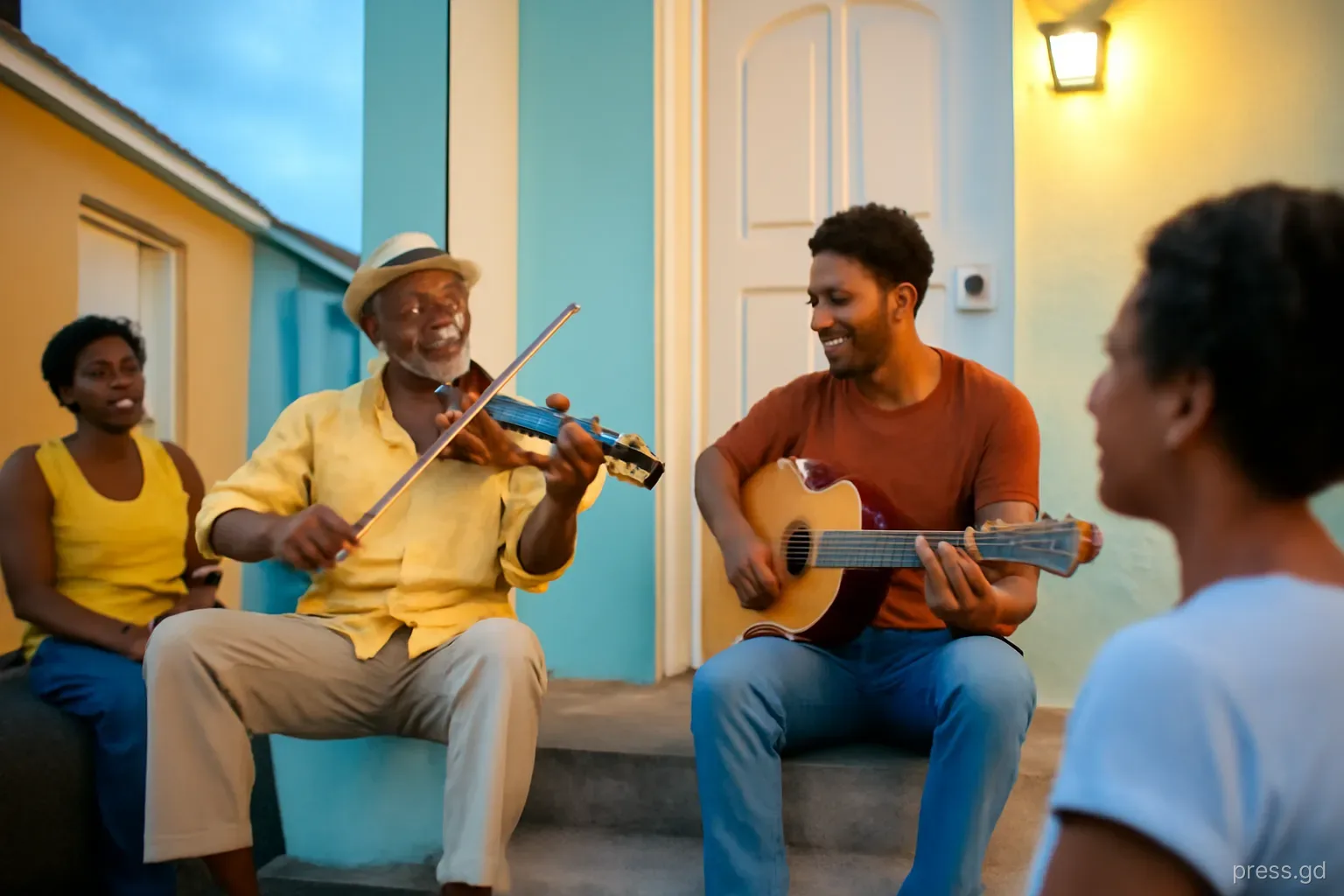
In most of the Caribbean, Christmas music means steelband carols, soca parang or imported pop. In Carriacou it can still mean a group of musicians with a fiddle, guitars, a cuatro and a shak-shak arriving at a house after dark, singing verses that tease the household about everything they did wrong in the past year. The hosts are expected to laugh, offer food and drink, and perhaps pay the musicians to move on to the neighbours.
This is parang, Carriacou-style, and it sits within a wider string band tradition that also accompanies quadrille dancing and village celebrations. It is one of the most distinctive musical cultures in the region, studied by ethnomusicologists and cherished by islanders. This explainer sets out how the music works, how it differs from parang elsewhere and when you might hear it.
What a string band is
A Carriacou string band is a small acoustic ensemble built around stringed instruments. The fiddle, or violin, traditionally leads the melody. Guitars and the cuatro, a small four-stringed instrument common across the southern Caribbean and Venezuela, provide rhythm and harmony. Banjo or mandolin may join, along with percussion: the shak-shak, a shaker, and tambourine or drum depending on the players available.
The repertoire mixes European dance forms, brought by planters and absorbed over generations, with Caribbean rhythms and local songs. Waltzes, polkas, reels and quadrille figures sit alongside calypsos and island compositions. Bands play at weddings, boat launchings, village fetes and Maroon celebrations, and in the past would have provided most of the dance music on the island.
The tradition has always relied on informal teaching: younger players learning by sitting with older ones. That makes it vulnerable when young people migrate, a concern that islanders and festival organisers have raised repeatedly over the years.
How Carriacou parang differs from parang elsewhere
Language. In Trinidad, parang is sung largely in Spanish, reflecting Venezuelan influence. Carriacou parang is sung in English and local Creole, which makes its lyrics accessible to everyone on the island.
Satire. The heart of Carriacou parang is the teasing serenade. Verses comment on the private and public behaviour of the people being serenaded, the village and the island at large. Romance, quarrels, meanness, scandal and misbehaviour all feature.
House visits. Groups traditionally move from house to house through the Christmas season. Hosts are expected to welcome them with food and drink, and the exchange is part of the social glue of village life.
Competition. Over time, parang has also become a staged competition, with bands preparing new songs and competing for prizes at the annual festival.
Accountability by song. Because the verses can be pointed, parang works a little like calypso: a communal way of noting bad behaviour without formal confrontation. Being sung about is a mild public sanction.
The Parang Festival and the Hosannah bands
Carriacou's Parang Festival takes place in December, usually on a weekend shortly before Christmas. It brings together string bands, singers and dancers for several nights of performance and competition. The string band contest is the climax, with bands presenting their newest satirical songs before judges and a crowd that knows every local reference.
The festival programme has also included quadrille dancing and Hosannah bands. Hosannah singing is an unaccompanied, choral tradition associated with Christmas, with groups singing hymns and carols in close harmony. It provides a striking contrast to the playful string band material and shows the religious side of the season.
As with any community festival, the details change from year to year, and the impact of Hurricane Beryl on Carriacou in July 2024 disrupted many events and venues. Anyone planning a December trip around the festival should check the current programme with local organisers or the Grenada Tourism Authority before booking.
Quadrille: the dance the string band serves
Quadrille is a set dance of European origin, performed by couples in a square formation through a sequence of figures. It arrived in the Caribbean in the colonial era and was taken up across the islands, adapted with local steps, music and humour. In Carriacou it survived longer and more vividly than in many places, and it remains closely tied to the string band.
A quadrille performance needs musicians who know the tunes for each figure and dancers who know the patterns. Elders have been the main keepers of the dance, and efforts to teach it to younger people have been an important part of cultural preservation on the island. Seeing it performed well, with the fiddle driving the dancers through the figures, is one of the pleasures of a Carriacou festival.
Ethnomusicologist Rebecca Miller's study Carriacou String Band Serenade documents the relationship between the music, the dance and community life in detail, and is the best published source for readers who want to go deeper.
Mistakes newcomers make
Visitors who stumble on a string band or parang group sometimes misread what is happening.
- Thinking it is a tourist show. Most string band music is made for islanders. Visitors are welcome, but the songs are not performed for them.
- Taking offence at the teasing. Parang verses can be sharp, but they are part of a known game. If you are serenaded, laugh and offer refreshments.
- Assuming it is Spanish parang. Carriacou's tradition is distinct from the Venezuelan-influenced parang of Trinidad, in language, content and spirit.
- Ignoring the elders. Older musicians and dancers are the authorities. Ask them about the songs and they may tell you the history behind them.
- Filming without asking. House visits are private occasions. Ask before recording, especially indoors.
When and where to hear it
December is the obvious time, with parang groups active through the Christmas season and the festival as its focal point. Late April brings the Carriacou Maroon and String Band Music Festival, which combines the island's Maroon tradition, the Big Drum and string band music across several days; recent editions have been held at the end of April. String bands also appear at weddings, launchings and village events through the year, though these are community occasions rather than public performances.
On mainland Grenada, string band music is less prominent but not absent; it appears at cultural shows, Independence events and heritage programmes. Recordings of Carriacou string bands exist, including field recordings made by researchers, and are a useful introduction before a visit.
Because schedules depend on local organisers and on the island's continuing recovery after 2024, always confirm events close to the date.
Getting there is part of the planning. Carriacou is reached by ferry from St George's or by short flights from Maurice Bishop International Airport, and accommodation on the island is limited, especially in festival weeks. Book transport and rooms well ahead, and allow for weather delays on the crossing in December and April alike.
Why the tradition survived in Carriacou
Several factors help explain why string band music and parang remained so strong on Carriacou while fading in many other places. The island is small and closely knit, with village life organised around shared occasions such as launchings, weddings, wakes and Maroon celebrations. Each of these events needed music, and string bands supplied it for generations before amplified sound systems arrived.
Isolation played a part too. Until regular ferries and flights made travel easier, Carriacou depended on its own entertainers, and older forms were not quickly displaced by imported fashions. The island's strong sense of identity, expressed also in the Big Drum, boatbuilding and its own carnival traditions, gave cultural continuity a high value.
Migration has cut both ways. Many Carriacouans live in Trinidad, North America and Britain, which drains the pool of young musicians at home. Yet the diaspora also returns for festivals, supports cultural events financially and records and shares the music online, helping it reach audiences who would never otherwise hear a Carriacou fiddle.
Frequently asked questions
What instruments are in a Carriacou string band?
A typical band is led by the fiddle, with guitars and the four-stringed cuatro for rhythm and harmony. Banjo or mandolin may join, along with percussion such as the shak-shak, a shaker, and sometimes tambourine or drum, depending on the musicians available.
How is Carriacou parang different from Trinidad parang?
Trinidad parang is sung mainly in Spanish and reflects Venezuelan roots. Carriacou parang is sung in English and Creole and is famous for its satirical verses, which tease households and the community about the year's gossip and misbehaviour.
When is the Carriacou Parang Festival?
It is held in December, usually on a weekend shortly before Christmas, with string band competitions, quadrille and Hosannah singing. Dates and programmes change from year to year, particularly since Hurricane Beryl, so check with organisers before travelling.
What is a Hosannah band?
A Hosannah band is a group that sings religious songs, hymns and carols in unaccompanied close harmony, associated with the Christmas season in Carriacou. Hosannah singing has featured in the Parang Festival programme alongside the string bands.
Is there a book about Carriacou string bands?
Yes. Rebecca Miller's Carriacou String Band Serenade is a detailed ethnomusicological study of the music, the quadrille dance and the role of string bands in island life. It is the most thorough published source available in English.