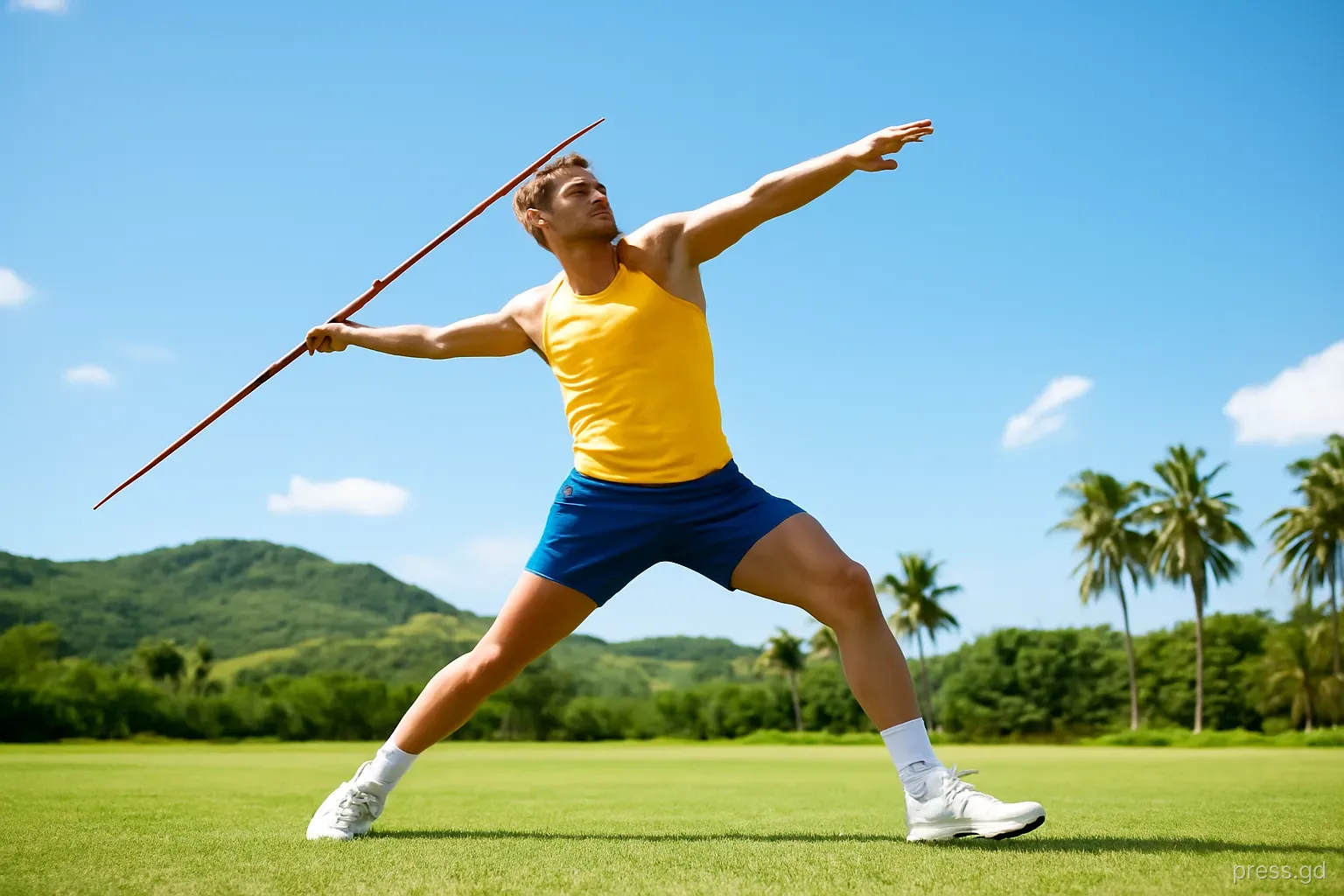
For most of athletics history, the javelin belonged to northern Europe. Finland, Norway, Germany and the Czech Republic produced the champions and set the records. Then, in 2019 and again in 2022, the world title went to a thrower from the parish of St Andrew in Grenada. Anderson Peters became only the second man to win back-to-back world javelin titles, and the first since the 1990s.
His story is worth understanding on its own terms, but it also explains something broader: why a Caribbean island better known for sprinters now produces genuine world-class throwers, and what that says about how talent is found and developed in Grenada.
From St Andrew to a US scholarship
Anderson Peters was born in 1997 in St Andrew, Grenada's largest parish, on the island's east side. Accounts point to the Soubise area, a coastal community near Grenville. Like many Grenadian athletes he came through school athletics, where throwing events were already getting more attention after a generation of local coaches began to specialise in them.
His junior results earned him a place at Mississippi State University in the United States, where he competed in collegiate athletics and won national titles. US college athletics gives a thrower things that are hard to find at home: daily specialist coaching, strength and conditioning staff, physiotherapy and a calendar of high-level competition. Peters represented Grenada at the 2018 Commonwealth Games on the Gold Coast in Australia, where he won bronze, one of the first signs that he could compete with the best in the world.
The college route has a cost that is rarely discussed at home. Athletes leave Grenada as teenagers, train through North American winters and spend most of the year away from family. Many return only between seasons. When Grenadians celebrate a world title, they are also celebrating years of sacrifice that took place largely out of sight.
The career in five results
Doha 2019. Peters won the world title in Qatar with a throw of 86.89 metres, a breakthrough that announced him as a contender for every major championship afterwards.
Doha 2022. At the Doha Diamond League meeting in May 2022 he threw 93.07 metres, a North, Central American and Caribbean area record and one of the longest throws seen in the event in years.
Eugene 2022. He defended his world title in Oregon, joining a very short list of men to win the javelin at consecutive World Championships.
Birmingham 2022. He took silver at the Commonwealth Games, improving on his 2018 bronze.
Paris 2024. After a disappointing Tokyo Games, he won Olympic bronze in Paris, one of Grenada's two medals there, and later that year took the Diamond League title in Brussels.
The setbacks: Tokyo and the 2022 assault
Elite careers are rarely straight lines, and Peters's has had two very public low points. At the Tokyo Games, held in 2021, he arrived as reigning world champion but did not reach the final, a reminder of how unforgiving the javelin qualifying round can be: a thrower has only a few attempts to clear a distance, and a slight technical fault can end a championship in minutes.
The more serious episode came in August 2022, weeks after his second world title, when he was assaulted on a boat in Grenada during a private event. The incident caused shock across the Caribbean athletics community and prompted condemnation from the government and sporting bodies. Several men were charged in connection with it. He returned to competition, and the medals he won afterwards, including the Olympic bronze, are read in Grenada partly as a story of recovery.
Both episodes illustrate the pressure on an athlete who becomes a national figure in a small society. Visibility brings sponsorship and recognition, but also a level of exposure that sprinters and throwers from larger countries rarely face.
How a javelin competition works
Understanding the format helps explain both Peters's triumphs and his disappointments. At a World Championships or Olympics, the competition begins with a qualifying round, usually split into two groups. Each thrower gets up to three attempts to reach an automatic qualifying distance, often somewhere in the low to mid 80-metre range for men; if fewer than twelve reach it, the longest throwers fill the remaining places in the final.
In the final, every athlete has three throws, then the top eight get three more. Only the single best legal throw counts, so one perfect release can win a title. A throw is a foul if the athlete steps over the arc at the end of the runway, or if the tip of the javelin does not land first within the marked sector. Wind matters more than in most events: a gentle headwind can help a javelin float, while gusts make the implement hard to control.
This is why world rankings and season bests are only a guide. Peters has won titles with throws shorter than his best and lost competitions in which he was the favourite.
Why Grenada produces throwers
Peters is not an isolated case. Grenadian throwers have been among the most consistent performers at CARIFTA for years, and at the 2024 CARIFTA Games in St George's the country's medals included a silver in the under-20 boys' javelin. Lindon Victor, the decathlete, is also known for his throwing events, setting Commonwealth Games meet records in the discus and javelin on his way to gold in 2018.
Several explanations come up in discussions among coaches and administrators. Throwing events need open fields more than expensive facilities, and school sports grounds can host them. Physical strength developed in active outdoor lives is often cited, though it is a generalisation to be careful with. More concretely, Grenada has had coaches who chose to specialise in throws, and success breeds imitation: once children see a Grenadian winning world titles in the javelin, more of them pick one up.
There is also a regional pattern. Trinidad and Tobago's Keshorn Walcott won Olympic javelin gold in 2012, the same Games in which Kirani James won the 400 metres, and the success of Caribbean throwers has encouraged schools across the region to invest more in field events.
What his success means for young athletes at home
In Grenada, the clearest effect of Peters's titles is visible at school sports meetings, where javelin competitions now attract more entrants and more spectators than they once did. Children who might previously have been steered towards sprinting see a realistic alternative, and parents understand that a strong throwing arm can lead to a college scholarship in the same way as fast legs.
The equipment question remains a practical constraint. Competition javelins are expensive, need to be the right weight for each age group, and wear out. Schools and clubs often depend on donations, and youngsters may share a small number of implements. Coaches have argued that if Grenada wants to keep producing throwers, the basic kit, safe throwing areas and qualified coaching in every parish need steady funding rather than one-off gifts after a big championship. Peters himself has spoken about wanting to give back to the young athletes following him, a commitment Grenadians will expect to see.
What fans often get wrong about the javelin
Coverage of Peters sometimes carries assumptions that do not survive a closer look at how the event works:
- Distance is not everything in a championship. Medals go to the best single throw on the day, and conditions such as wind direction can change results more than personal bests suggest.
- The 93.07-metre throw came at a Diamond League meeting, not at a World Championships or Olympics, so it is not a championship record.
- Qualifying rounds are where many favourites fall. Missing the Tokyo final did not mean Peters had lost form permanently, as his later titles showed.
- Javelin careers can last into an athlete's thirties, so Peters, born in 1997, may have several more championships in him if he stays healthy.
- His titles are often listed as Grenada's first world championships, but Kirani James won the world 400 metres title in 2011, eight years before Peters's first.
Frequently asked questions
Where is Anderson Peters from?
He was born in 1997 in the parish of St Andrew on Grenada's east coast, with accounts pointing to the Soubise area near Grenville. He later studied and competed at Mississippi State University in the United States.
How many world titles has Anderson Peters won?
Two. He won the javelin at the 2019 World Championships in Doha and defended the title at the 2022 World Championships in Eugene, Oregon, becoming one of very few men to win consecutive world javelin titles.
What is Anderson Peters's best throw?
His best is 93.07 metres, thrown at the Doha Diamond League in May 2022. It set a North, Central American and Caribbean area record and placed him among the longest throwers in the event's modern history.
Did Anderson Peters win an Olympic medal?
Yes, a bronze in the javelin at Paris 2024. It was one of Grenada's two medals at those Games, alongside Lindon Victor's bronze in the decathlon. He did not reach the final in Tokyo.
What happened to Anderson Peters in 2022?
In August 2022 he was assaulted on a boat in Grenada during a private event, shortly after winning his second world title. Several men were charged, and the incident drew condemnation from officials and athletes across the region.